Thứ Ba, 8 tháng 11, 2016

Hillary Clinton makes final election push with help of Barack Obama and rock star friends at site of American independence

From the acoustics of Bruce Springsteen, to the adoration of Michelle Obama and the respect of the president of the United States, Hillary Clinton was cocooned in love. 
Standing before a crowd of thousands at the very place where the Declaration of Independence was signed and the Constitution was adopted, these political and cultural giants made their pitch for why Mrs Clinton must become first woman president of the United States. 
"Philadelphia, in this place, where our Founders forged the documents of freedom, if you share my faith, then I ask you to vote," an emotional Barack Obama said. 
"I am asking you to work as hard as you can this one last day to elect this fighter, this stateswoman, this mother."
Democratic presidential candidate Hillary Clinton, center, is joined on stage by first lady Michelle Obama, left, President Barack Obama, second from left, Chelsea Clinton, second from right, and former President Bill Clinton, right, after speaking at a rally at Independence Mall in Philadelphia
It was a speech fitting for the night that will be marked as a moment in America's history books. The event at the city's Independence Hall was the Democrat's final push on the eve of an election that has become a referendum on the character of a nation.
Taking the stage last, Mrs Clinton presented herself as the candidate for the future, and warned that a ballot for Donald Trump was to regress  "back in time" to a darker age.
"None of us want to wake up on Wednesday and wish we had done more," she said. "I want you to be able to say that you voted for a big hearted open minded country because I believe we are stronger together.
Reflecting on the long, tough, slog of her almost 18-month-campaign she said: "I regret deeply how angry the tone of the campaign became."
A woman  in the crowd to shout out, "Not your fault!"
Donald Trump waves to supports at the end of his rally in Manchester, New Hampshire
Eight years ago Mr Obama and Mrs Clinton had been rivals for the presidential seat. But on Monday it was Mr Obama who delivered the speech that could well win her the election. 
It was a moment that highlighted why Mrs Clinton has needed the Obamas on her side in this presidential race. 
He was passionate and lyrical, relaxed and determined, and, as has always been the case, wholly more effective a speaker than she - with her awkward, careful public persona -  could hope to be.
Fired up by Donald Trump, a man he considers dangerous and who has promised to undo every bit of his legacy, the president has thrown himself into campaigning against him.
He made himself a servant of the Clinton campaign, spending these final weeks criss-crossing the country to stump for her. But no speech was more passionate and effective than the one he delivered at this final address.
Crowd gathers at Independence Hall for Hillary Clinton's closing rally ahead of the election
His words ringing out into the cold night air, he said Mrs Clinton had suffered more personal attacks than any politician. 
"But like the American people, she is strong and tough and she knows that public service is not about her: it's about you," he said,  "She will work her heart out for you."
And in classic Obama style, the president quipped a dig at Donald Trump:  "She will work and she will deliver. She won't just tweet."
Addressing a crowd of some 20,000 people, protected by a bullet proof glass, he took the opportunity to pay tribute to the nation he leads.
"I have seen again and again your strength and your heart," he said.  "I have always had the odds on my side because I am betting on you."
US Democratic presidential candidate Hillary Clinton (L) and US First Lady Michelle Obama (R)
By the time Mrs Clinton came on stage, she had been lavished in praise by her daughter, her husband, Mr Obama and the first lady.
"She is an outstanding mother, loyal loving wife, inspiration to me," said Michelle Obama, a figure more loved by Americans than even her, already popular, husband. 
"In just a few hours we have the power to make her our next president, how amazing is that?" 
Earlier Jon Bon Jovi and Bruce Springsteen had serenaded the crowd. The latter had set the tone for a special night.
His dulcet voice was a world away from the fast electronic, pop beats of Katy Perry who headlined for Mrs Clinton in Philadelphia on Saturday night.
That was a whirl of action, strobe and smoke lines designed to whip up a young crowd. But the music was mechanical - in the beginning Ms Perry's recorded songs had been blasted from loud speakers with the singer seeming to join in with the occasional lyric.
Tonight Mr Springsteen accompanied his songs with an acoustic guitar. The crowd was caught in the magic of the moment, swaying gently together on the historic site.
Still strumming soothingly, Mr Springsteen rhapsodised about the election: "Now briefly to address our opponent," he said. "This a man whose interest is little beyond himself."
He played "Long Walk Home", a song which he wrote at the end of the Republican presidency of George W Bush.
"Tomorrow that campaign is going down," he said to cheers.  He called on voters to do their part tomorrow "so we can say we were all on the right side of history."

More games: Friv

Thứ Tư, 14 tháng 9, 2016

Obama plans to increase number of refugees to US

The Obama Administration plans to increase the number of refugees admitted to the United States by 30 percent in fiscal year 2017, according to the Wall Street Journal, which cited an annual refugee report submitted to Congress.

Secretary of State John Kerry presented the new target of 110,000 in the 2017 fiscal year starting Oct. 1, up from 85,000 in 2016, during a closed session to members of the House and Senate judiciary committees on Tuesday, according to the newspaper.

Kerry has said repeatedly over the past year that the United States would admit at least 100,000 refugees in fiscal 2017 and try to admit more if it were able.

Syrian refugees

Meanwhile, a federal appeals court in Chicago is set to hear arguments in Republican Indiana Gov. Mike Pence’s appeal of a ruling that blocked his order to bar state agencies from helping Syrian refugees resettle in Indiana, the Associated Press said.
The appeals court is considering the case Wednesday, about two months before voters decide if Pence will be the nation's next vice president. After the November Paris attacks, Pence said he didn’t believe the federal government was adequately screening refugees from war-torn Syria. In February, a federal judge found Pence's order discriminatory against refugees.
Pence administration attorneys say the directive is “narrowly tailored” in the interest of public safety. But the American Civil Liberties Union of Indiana argues refugees are extensively vetted and the state's argument is “built on fear.”
With AP inputs.

Thứ Sáu, 29 tháng 7, 2016

Barack Obama: I don't eat exactly seven almonds every night

New York Times anecdote about how the president eats only ‘seven lightly salted almonds’ as a late-night snack was told to reporter ‘as a joke’, Obama says.

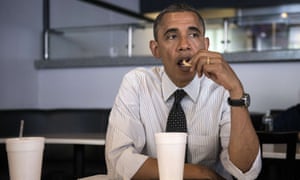
Obama eating

Rumors of Barack Obama’s particular fondness for almonds have been greatly exaggerated.
Politicos marveled at the president’s discipline after a New York Times article published earlier this month asserted that the commander-in-chief consumes only “seven lightly salted almonds” as a late-night snack, particularly in light of his tour de force speech at the Democratic national convention in Philadelphia on Wednesday night.
To stay awake, the president does not turn to caffeine. He rarely drinks coffee or tea, and more often has a bottle of water next to him than a soda. His friends say his only snack at night is seven lightly salted almonds.
“Michelle and I would always joke: Not six. Not eight,” Mr. Kass said. “Always seven almonds.”
The paper sent out a memorable news alert to the piece reading: “After dark, President Obama spends hours alone, time he says is essential to think, write and have a snack – exactly 7 almonds.”
But although it is true that Obama spent nearly three weeks writing six different drafts of the address, he told NBC’s Savannah Guthrie in an interview aired on Thursday that he was running on more than just a handful of heart-healthy tree nuts.
“This is an example of the weird way that the press works,” Obama, when asked why he doesn’t ever cut loose and eat eight almonds.
“So, Michelle [Obama] and Sam Kass, who was our chef here, one night they were talking about me and teasing me about how disciplined I was, that I didn’t have potato chips or I didn’t have a piece of cake,” Obama explained.
“And this is when Michelle said: ‘Yes, and he just has seven almonds. That’s it.’ To really drive home the point that I needed to loosen up a little bit. And Sam relayed this joke to the New York Times in the article and somehow it was relayed as if I was counting out the seven almonds.”
In reality, Obama has a fondness for junk food, once telling a children’s state dinner meant to encourage healthy eating habits that his “big thing” is tortilla chips and guacamole.
When a bowl is in sight, “he loses it”, first lady Michelle Obama said with a rueful head shake at the event.
“I lose my mind,” Obama responded. “I lose my mind!”
Perhaps with the first lady’s nutrition platform in mind, Obama said that despite the exaggeration in the original report, “almonds are a good snack – I strongly recommend them.”
“I am so glad I had this opportunity,” Obama continued. “This has been really weighing on me.”

Thứ Tư, 22 tháng 6, 2016

Punting on Politics

Donald Trump has publicly courted Tom Brady and Ben Roethlisberger for endorsements to validate his tough-guy persona, but athletes are being advised to steer clear of the political arena with these two candidates
Getty Images / Illustration by The MMQB
At a rally in Richmond, Virginia earlier this month, Donald Trump told a crowd of supporters, “Our country needs to see winners. We don’t see winners anymore.” With that, he launched a public courting for two Super Bowl champions to speak on his behalf at the Republican National Convention in July: Tom Brady and Ben Roethlisberger.
“We’re going to do it a little different, if it’s OK,” Trump told the crowd. “I’m thinking about getting some of the great sports people who like me a lot.” While Brady and Roethlisberger are known acquaintances of Trump’s—their relationships with were cultivated through golf—Brady has remained mum on the possibility of stumping while Roethlisberger told the Pittsburgh Post-Gazette’s Ed Bouchette he won’t attend the convention or endorse any candidate.
As the NFL breaks for summer vacation, I wanted to explore what role, if any, NFL players will have in the 2016 election. The informal polls I took suggest minimal engagement.
“Typically, we advise our athletes to shy away from discussing politics, religion or finances,” says Denise White, CEO of the marketing and branding agency EAG, which counts two dozen NFL players as clients. “But this year I’ll tell my guys: ‘I don’t care who you are voting for, keep it to yourself.’ It’s not the right climate to be aligning yourself with either candidate, considering how polarizing both Trump and Hilary [Clinton] are.”
Athletes haven’t always shied away from politics. In 1928, presidential hopeful Al Smith featured Jack Dempsey, Arnold Horween and Lou Gehrig on campaign posters. Vince Lombardi endorsed John F. Kennedy; Wilt Chamberlain spoke out for Richard Nixon. But the landscape started changing around the mid-1980s when athletes began marketing themselves as commodities. In 1990, Michael Jordan famously refused to endorse Harvey Gantt, the black mayor of Charlotte who was running against noted racist Jesse Helms for a Senate seat. Jordan’s enduring quote: “Republicans buy sneakers too.”
“Sports figures are often beloved because they offer us a respite from things like politics,” says Kevin Madden, a Republican strategist and senior advisor on Mitt Romney’s 2012 campaign. “So if you’re an athlete, and you choose a side politically, you’re setting yourself apart, potentially, from half of your fan base. Partisanship is very real. You’re involving yourself in political debates that are much more volatile than even the toughest playoff race.”
Adds White: “If you marry yourself with a candidate, you’re marrying yourself with every policy that candidate stands for, whether you agree or not. Think about Trump. He has pretty much offended every race and ethnic background. Why I would tell my guys to stay away from Trump: even if you agree with something he says, you don’t know what’s next. We still don’t quite know what his policies are, or what group of people he will alienate.”
Golfer Jack Nicklaus and Red Sox pitcher Curt Schilling campaigned for George W. Bush in 2004. The list of NBA and NFL players who publicly endorsed Barack Obama is extensive (even Jordan co-headlined a Barack Obama fundraiser in 2012). White said many of her clients supported Obama, and she felt comfortable with them doing so publicly. “It wasn’t just that he would be the first black president,” White said. “It was his outlook for the country, his policies, and that he was for the people, not just for minorities. We knew where he stood, and if my guys felt strongly about that, we told them to go for it and helped them get behind him.”
“Campaigns do seek out athletes,” says Madden. “Because the best athletes are associated with all the attributes you’re acutely attaching to your candidate: winning, determination, reliability, relatability.”
Trump, especially, has aligned himself with sports figures—or at least tried to. “The core of Trump’s campaign has been his claim to super masculinity,” says University of Texas professor John Hoberman, who has written extensively on sports and politics. “He is campaigning as an alpha male. He has made repeated claims to be endorsed by athletes and he wants to be associated with these tough-guy athletes, because they validate that message.”
Trump’s attraction to Roethlisberger is natural. Says Madden: “A lot of what Western Pennsylvania identifies with Ben Roethlisberger and the Steelers—gritty, blue-collar, work ethic—that’s gold for Trump.”
And yet Roethlisberger, who tends to be very private off the field, told reporters at minicamp, “I’m not getting into politics during my playing career.” It’s not just a media distraction, but a logistical one. The RNC is July 18-21, roughly a week before the Steelers open training camp. “Come this fall, it’s football season,” White says. “They’re out there playing, they’re not able to be on the campaign trail or appearing at rallies. And this year, they definitely shouldn’t be.”
Now on to your mail…
• EMILY KAPLAN’S MMQB: In a final cram before summer, she covers Jay Cutler’s defining season to come, the no-growth HGH investigation, the weird off-field predicaments of rookie QBs, a marijuana crusade, Rex Ryan’s bluster and bicycle, and the mom who just might overshadow all the Father’s Day tributes
 
You can’t compare what John Fox did in Denver with Peyton Manning to what he might be able to do with Jay Cutler in Chicago. Cutler hasn’t done anything worthy of that comparison. GM Ryan Pace overhauled the defense with 10 new starters—that has never been a recipe for success or every team would do it. It’s a hand-in-the-air gamble. As for the Bears giving Cutler the “best opportunity to thrive,” come on, man. An untested, inexperienced office with oversight from a brand new offensive coordinator with a head coach who only finds success with an already proven HoF QB …  hardly the best opportunity.
— C. Calving
The climate John Fox entered in Chicago is exponentially different than what he had in Denver. And in no way would I compare Cutler to Manning, nor did I. However, I believe Fox learned lessons from his four years in Denver that he’ll apply in his current job. For example, when Manning thrived in 2012—setting single-season franchise records for completion percentage (68.6), passer rating (105.9), passing yards (4,659) and TD’s (37)—Denver’s offensive coordinator, Mike McCoy, became one of the hottest head coaching candidates in the league (and was hired by the Chargers). The Broncos promoted then-quarterbacks coach Adam Gase because, as Fox told me, “he had a great relationship with Peyton”—and they didn’t want to tinker with a good thing.
Adam Gase went to Chicago with Fox, but is now the head coach in Miami. Cutler had the best season of his career in 2015, in a system that blended concepts from several influencers (West Coast, deep shots, play action) that Gase had tailored to Cutler’s strengths. Wouldn’t you know it: Gase became the hot head-coaching job candidate. The Bears did exactly what the Broncos did three years ago: they promoted from within, which Fox was smart to do.
As for the defensive overhaul: Most teams don’t endure such voluminous turnover in such a short timeframe. However, Pace brought in defensive coordinator Vic Fangio, who flipped the unit from a 4-3 to a 3-4 base. With a drastic switch in defensive philosophy, Pace needed players who could fit that scheme.
* * *
My question is with respect to Dirk Koetter’s comments.  Specifically, I would propose that he should be fired on the spot if he's really going to coach that way—doing what he knows to be “mathematically wrong” because a) he wants to avoid criticism and b) he wants to justify a sunk cost (the previous draft pick). That mind-set reflects fear, not leadership, and if I were the owner I'd have some hard questions for my new HC. Is this mind-set widespread in the NFL? No wonder guys like Bill Parcells and Bill Belichick— who couldn't care less about media reaction—win at an extraordinarily high rate.
— Dan Breen
The worn adage is that the NFL is a copycat league, but often times I find it to be a groupthink league. You can find examples at almost every level. Consider each year a crop of “hot coaching candidates” sprouts, and every team with a vacancy scrambles to woo them. These candidates are almost always an excellent play-caller who transformed a once-middling offense or defense. Their hiring would be considered a “win” for the fan base (last year’s group: Adam Gase, Hugh Jackson, Ben McAdoo). Rarely do teams deviate from this mold, and when they do (Titans; Mike Mularkey) they are instantly critiqued. The common theme here is risk-aversion. It’s a transient league in terms of employment. Anytime someone deviates from quo (think of Chip Kelly’s wholesale changes in Philadelphia) they become vulnerable.
Last year, the only team to regularly incorporate the two-point conversion was the Steelers (they went for two 11  times, compared to 34 extra-point attempts) though it seemed Mike Tomlin’s rationale was swayed by the team’s kicking woes. Until a team takes the plunge and proves that going for two is sustainably effective, expect for everyone to keep on kicking, just as they always have.
* * *
Having lived in Chicago since 1999, Chicago-style “pizza” is an abomination. Try Piece in Bucktown, or Little Pops out in Naperville. Both have very good East Coast pizza.
— Jake Schmidt
As a kid who grew up in Chicago (the city part), I thought it my duty to explain away some misconceptions about Chicago pizza. Yes, most Chicagoans don’t have a problem with tourists thinking that Chicago pizza is deep-dish or stuffed. But Chicago pizza, for Chicagoans, depends on which neighborhood you live in. I grew up on the Northwest Side (Irving Park). Our neighborhood pizzeria (also Italian restaurant) was La Villa. They serve thin crust pizza. The ingredients, especially the sausage, make it outstanding. To me, Chicago pizza is La Villa Pizza.
There are some neighborhoods where deep-dish is the neighborhood style. So it's not limited to my neighborhood joint. Some have super thin crust, too. So I hope you get the idea. For what it's worth... maybe not much...
— David
I knew my pizza take was going to get some reaction, but I was completely taken aback by the emails, Twitter comments and Facebook messages. Thank you, Jake and David, among many others, for recommending new spots. And I’m totally fine with still being called a tourist. I suppose I deserve that from basing my review of Lou Malnati’s and slices from four other unmemorable establishments. No, I have not yet been to Peaquod’s, but according to my offended Chicago friends, that will change soon. Also, I’d like to make an amendment to my initial review, when I said that deep-dish should be called a calzone. The more appropriate comparison is a quiche.
* * *
Emily, when you say Tom Brady should admit to something, you are either assuming he actually deflated the footballs (does any rational person equipped with the facts still think this?) or you think he should lie. Not a tenable position.
— Joe McKenney
Thanks for your note, Joe. This is one of a few letters I received on this topic, and I understand your point. Perhaps I was a bit limiting in my stance here: when I say Tom Brady should admit to something—“anything” as I phrased it—I’m not saying he has to tell the NFL he orchestrated a grand scheme to deflate balls. And if he didn’t orchestrate such a scheme, or even deflate balls at all, then obviously he should not lie. I know Brady reportedly made a “generous” settlement offer which the NFL turned down in May, though terms of that offer were never made public, nor was the rationale by the league for turning it down. What I’m saying here is this: Brady is almost drained of legal recourse. The type of appeal he is seeking is rarely granted. While the NFL may have had some incentive to budge last year, they certainly don’t now. If Brady wants to find any way to reduce his four-game suspension, he should revisit whatever he was going to offer back then. I don’t know what it was, but it could help reduce the four-game suspension.
* * *
How do you top the Mandy Moore “Candy” video, the “Gleason” trailer, and a dis at Chicago deep-dish?
The priceless Adieu Haiku!
— Dave
Thanks for the note, Dave. I was scared only four readers might get the Mandy Moore “Candy” video reference. I’m glad you were one of them.

Thứ Ba, 17 tháng 5, 2016

Barack Obama's Hiroshima trip stirs debate on Harry Truman's fateful choice

Barack Obama's visit to Hiroshima next week has reignited an emotive debate over former US president Harry Truman's epoch-making decision to drop the first atomic bomb.
On April 25, 1945, 13 days after Franklin Roosevelt's death thrust Truman into the White House, the strained new commander-in-chief got a startling top secret briefing.
"Within four months we shall in all probability have completed the most terrible weapon ever known in human history, one bomb of which could destroy a whole city," war secretary Henry Stimson said in a hand-delivered memo.
Until that moment, Truman had no idea about the Manhattan Project to build the world's first atomic bomb — despite being Roosevelt's vice president and a former senator who made his name investigating wartime defence contracts.
Within four months, the atomic bomb had been successfully tested, targets had been selected, "Little Boy" and "Fat Man" had been dropped on Hiroshima and Nagasaki killing an estimated 214,000 people, and Japan's Emperor Hirohito had surrendered.
The speed, circumstances and repercussions of Truman's decision remain contentious.
That is true not least in Japan, where a majority of Mr Obama's hosts still believe the mass bombing of civilians was unnecessary and perhaps even a crime.
Meanwhile commentators nervous that Mr Obama's trip is tantamount to an admission of guilt, have urged him not to apologise.
"When Mr Obama visits Hiroshima on May 27 he should place no distance between himself and Harry Truman," wrote Wilson Miscamble, a Notre Dame University history professor.
"Rather he should pay tribute to the president whose actions brought a terrible war to an end."

'Kamikaze spirit'

Harry S Truman, US president 1945-1952.PHOTO: Harry S Truman, US president 1945-1952.(Office of the US President)
For Truman's supporters, "Give 'em hell Harry" had little option.
By late Spring 1945, American and Russian forces had met at the Elbe, Adolf Hitler was surrounded and the war in Europe was finally ending.
But the Pacific was exacting an ever bloodier toll.
Japan showed no signs of surrender, despite heavy losses and a seemingly inevitable defeat.
According to historian and biographer David McCullough, at that point not a single Japanese unit had surrendered during the war.
For Truman, a veteran of the Great War, the bomb, first and foremost, appeared to offer a way out of a brutal ground invasion of Japan.
"Operation Downfall," as the mainland invasion was dubbed, could have involved at least one million US troops and as many as 2.5 million Japanese troops.
With recent battles in Okinawa and Iwo Jima fresh in mind, US military planners believed the operation would cost a quarter of a million lives and extend the war by a year or more.
At the end of July, with the bomb now successfully tested, Truman gave Japan one last chance.
Meeting with Joseph Stalin and Winston Churchill at Potsdam, the three leaders called for Tokyo to "surrender unconditionally" or face "prompt and utter destruction".
The allies waited eagerly for a response, which was given by Japanese premier Kantaro Suzuki.
"Mokusatsu," he said when asked by reporters, using a word that would become infamous.
The phrase can mean "no comment," but in this instance was translated as "not worthy of comment".
"US officials, angered by the tone of Suzuki's statement and obviously seeing it as another typical example of the fanatical Banzai and Kamikaze spirit, decided on stern measures," a National Security Agency report on the dangers of mistranslation later noted.

A controversial decision

70th anniversary of Hiroshima bombingPHOTO: Doves fly over the Peace Memorial Park in Hiroshima in 2015 on the 70th anniversary of the atomic bombing of the city.(Reuters: Toru Hanai)
Within Truman's inner circle there were voices against using the bomb, including Dwight Eisenhower, the future president who was then a wartime general.
"I was one of those who felt that there were a number of cogent reasons to question the wisdom of such an act," he later wrote.
But there is little evidence that Truman ever seriously considered forgoing the fruits of a $US2 billion program that Roosevelt had nurtured in secret for years.
More likely he saw the weapon as a terrible, but useful extension of already terrible conventional weapons.
Neither did there appear to be a recognition that dropping the bomb would catalyse an arms race with the Soviet Union that would define the next half century.
When the bomb was dropped, Truman made little immediate mention of civilian casualties and a few days later even described Hiroshima as a "military base," spurring questions about whether he realised the scale of destruction.
But the White House is quick to scotch suggestions that Mr Obama will revisit the broader issue of whether the bomb should have been dropped at all.
Asked whether Mr Obama would make the same decision as Truman, aide and spokesman Josh Earnest said: "I think what the president would say is that it's hard to put yourself in that position from the outside."
"I think what the president does appreciate is that President Truman made this decision for the right reasons. President Truman was focused on the national security interests of the United States… on bringing an end to a terrible war. And President Truman made this decision fully mindful of the likely human toll," he said.
"I think it's hard to look back and second-guess it too much."

Thứ Năm, 7 tháng 4, 2016

Professor Barack Obama makes case for Supreme Court nominee Merrick Garland

WASHINGTON, D.C. — Briefly reviving his earlier-in-life position as a constitutional law professor, President Barack Obama sought Thursday to imbue his case for Supreme Court nominee Merrick Garland with academic heft, insisting Republicans hold hearings as a matter of legal responsibility.
Speaking at the University of Chicago Law School, where he taught for 10 years, Obama argued that without substantive concerns about Garland’s record, Republicans were blocking his nomination solely on political grounds.
And he pushed back on criticism Garland wouldn’t bring diversity to the court, claiming his past judicial nominations “transformed the courts from a diversity standpoint” and that he didn’t set out to find a candidate from a particular demographic.
“At no point did I say, ‘Oh, I need a black lesbian from Skokie,” Obama said, referencing the small Chicago suburb where Garland was raised. “Yeah he’s a white guy, but he’s a really outstanding jurist. Sorry, I think that’s important.”
“Merrick Garland is an extraordinary jurist who is indisputably qualified to serve on the highest court of the land. And nobody really argues otherwise,” Obama said. “No one has plausibly made an argument that this is not the kind of person we’d want on the Supreme Court. The question then becomes: Why is it so hard for the guy just to get a hearing and a vote?”
Obama and his allies have launched an aggressive pressure campaign on Republicans to take up Garland’s nomination, which Obama announced in a Rose Garden ceremony last month. They’ve argued Senate Majority Leader Mitch McConnell and the Republican chairman of the Judiciary Committee, Chuck Grassley, are shirking the Senate’s constitutional obligation to consider the President’s pick for the high court.
Obama on Thursday said the longer the high court goes without a full roster of justices, the higher the likelihood of the court becoming bitterly politicized.
“If you start getting into a situation in which the process of appointing judges is so broken, so partisan that an imminently qualified jurist cannot even get a hearing, then we are going to see the kinds of sharp partisan polarization that have come to characterize our electoral politics seeping entirely into the judicial system,” Obama said.
Grassley attacked Obama following his event, in a fundraising letter where the Iowa senator portrayed Obama’s Supreme Court campaign “a publicity stunt to get his way.”
“There is so much at stake in 2016,” Grassley wrote. “The opportunity to win back the White House, to secure the Republican Senate Majority and influence the direction of the Supreme Court for the next generation.”
During a town hall-style event, Obama was questioned about the Democratic race to replace him, which he said hadn’t reached nearly the level of rancor as the Republican side. But he warned his party against adopting an overly strict doctrine that excludes differences in opinion.
“The thing that Democrats have to guard against is something the Republicans are going much further along on, and that is this sense that we are just going to get our way, and if we don’t we’re going to cannibalize our own,” he said.
And while he didn’t delve deeply into the political race Thursday, Obama is expected to use the Supreme Court issue as a cudgel in the coming election.
While a growing number of Republican senators have agreed to meet Garland in their offices on Capitol Hill, that effort hasn’t yet produced a crack in McConnell or Grassley’s refusal to convene committee hearings on Garland’s nomination.
The first Republican to meet with Garland, Sen. Mark Kirk of Illinois, didn’t attend Obama’s event in his home state Thursday, but did receive a handwritten thank you note from the President for his “fair and responsible treatment” of the nominee.
“It upholds the institutional values of the Senate, and helps preserve the bipartisan ideals of an independent judiciary,” Obama wrote in the note, which Kirk posted on social media Thursday.
A day earlier, Obama and Vice President Joe Biden endorsed Kirk’s Democratic challenger for the Senate, Rep. Tammy Duckworth, signaling the President would actively campaign against the Republican incumbent as November’s election nears.
Asked about the decision to endorse Duckworth a day before visiting Chicago, White House spokesman Eric Schultz told reporters Obama made his decision based solely on the two-term congresswoman’s qualifications. But Democratic officials have said that they plan to use the Supreme Court issue against Republicans senators up for re-election, like Kirk, Kelly Ayotte of New Hampshire, Rob Portman of Ohio and Pat Toomey of Pennsylvania.
Obama — with an eye toward polls showing that even a majority of Republicans support hearings — hopes to drive a wedge between the Senate leaders and members of their party when he appears on Fox News this weekend. He planned to tape an interview with the network’s Sunday morning program after his session in Chicago. White House Press Secretary Josh Earnest said he hoped to reach an audience that “may not have heard from the President directly in a while.”
The trip to the Windy City amounted to a homecoming for Obama, as well as his daughter Malia, who accompanied her father on Air Force One en route to his speech. Obama spent a decade on the faculty of the University of Chicago law school, joining as a professor in 1992, teaching three courses a year until he was elected to the U.S. Senate in 2004. The school said Obama was invited several times to join the faculty in a full-time tenure-track capacity but declined.
The home Obama and his family still maintain in leafy Hyde Park was less than two miles from where Obama spoke Thursday.

Thứ Sáu, 29 tháng 1, 2016

Bernie Sanders tries to be the next Barack Obama in Iowa, not the next Howard Dean

Bernie Sanders delighted in telling a crowd of a couple of thousand people here this week about his journey from “fringe candidate” to serious contender for the Democratic presidential nomination, rattling off poll results reflecting his momentum and boasting that “the energy, the enthusiasm is with our campaign.”
But shortly before Sanders took stage, an organizer for his presidential campaign asked members of the crowd to raise their hands if they had signed up to volunteer. Only a few did.
“Oh, no. Not a lot of people here, I don’t think,” he said. “We need each and every one of you to rise to the occasion.”
It was a glimpse of Sanders’ toughest challenge as his sweeping call for a political revolution faces its first concrete test Monday in the Iowa caucuses. Their outcome will reveal whether the Sanders campaign operation, which has defied expectations with the enthusiasm it has drawn from disaffected liberals and college students, can harness that energy into votes the way Barack Obama did in 2008 when he beat the same establishment favorite Sanders now faces, Hillary Clinton.
Obama bested Clinton by motivating huge numbers of voters who normally wouldn’t participate in the caucus process to show up. Sanders himself is doubtful his campaign can reproduce the turnout Obama achieved, saying this week that the 2008 election “is really going to stay in the history books. It was an unbelievable campaign. In places they ran out of ballots, as I understand it.”
But he will be using a lot of the same organizational tools Obama did in claiming victory over a front-runner who seemed to have all the advantages in getting out the vote.
Targeting technologies pioneered by Obama’s campaign have made it possible for outsider candidates like Sanders to turn out Iowans who a decade ago might have showed up at a rally and then faded away before the caucuses. Now, computers can quickly link them up with a caucus coach who can walk them through the bewildering voting process and even make sure they have a ride on election night.
But ultimately, much of the work of sealing a commitment from voters happens through human contact. And to avoid the disappointment fellow Vermonter Howard Dean endured in the 2004 caucuses, when he failed to leverage similar insurgent momentum, the Sanders campaign has been rushing to build the infrastructure to capture enthusiasm and turn it into votes.
“The troops got beyond their supply lines,” Dave Nagle, a Democratic former congressman from Iowa, said of the Sanders operation. “Now they’re trying to catch up.”
Sanders has invested heavily in field offices, opening nearly two dozen in Iowa, just a few less than the much better-funded Clinton operation. The offices are a crucial hub for connecting with voters, and Obama opened an unprecedented 37 in Iowa in 2008.
Still, Sanders faces challenges unique to the organizational efforts this state demands. Nagle noted how his caller ID flashes with out-of-state area codes when Sanders volunteers reach out to him.
“God bless them that they’re here,” Nagle said. “But you want an Iowan talking to an Iowan.”
Another problem for Sanders is that everything he is doing, Clinton is also doing. Her campaign is determined not to be out-organized in Iowa again, and many of the strategists who set up Obama’s infrastructure are now working to elect her.
“Campaigns can target better and, thanks to a lot of rigorous experimentation, have a better sense of what actually gets potential voters to the polls,” said John Sides, coauthor of “The Gamble: Choice and Chance in the 2012 Presidential Election.” “But those tactics typically make a difference at the margins. So it's an open question whether better campaign tactics will bring Sanders a victory, especially since Clinton is, of course, using the same tactics.”
By June, more than six months before the caucuses, Clinton’s campaign had identified a committed supporter in every corner of the state. Student volunteers have been plying their campuses since the fall to sew up commitments from classmates.
“She’s built relationships over a long period of time,” said Jeff Link, a Democratic strategist in Iowa who isn’t working for a presidential candidate this year. “She has a lot of key supporters around the state.”
The enthusiasm for Sanders, meanwhile, tends to be concentrated in a few parts of the state where there are big college campuses. That creates a challenge on caucus night, when the victor is decided by how many local precincts choose them, not the total number of votes they garner statewide.
It’s a big problem that did not affect Obama, even though his support was also concentrated in college towns. The caucuses were held in early January of 2008, when most students were  home on break, so they voted all over the state.
Pete D'Alessandro, the Sanders campaign’s Iowa coordinator, said the concerns about geography are “a bit overblown.” Nonetheless, he wants help college students return to their hometowns to caucus, rather than just gathering on campus, to spread support as widely as possible.
“We’ve rented every van in a four-state area,” he said. “We want to be ready.”
The campaign has also sent organizers to speak in high school government classes, and Sanders sometimes meets with seniors before his events. Any student who will be 18 on election day in November is eligible to participate in the caucuses, and Sanders met with about 35 about them this month in Underwood, a town of about 900 people on the western edge of Iowa.
In such a small town, locking up support from young students “could change the outcome of that caucus,” D'Alessandro said.
Jordan Miller, an 18-year-old high school student from Sumner who went to hear Sanders speak on a college campus in Fayette in northeast Iowa, said he became a fan of the senator after watching the debates and researching his speeches on YouTube.
“I said, ‘This is the guy,’” Miller said. “Everything I support, he supports.”
Even in areas where Sanders and Clinton agree, such as fighting climate change, Miller said he finds the senator more credible.
“She’s like a robot,” he said. “Bernie talks with passion.”
It’s a pervasive view among young voters who have gravitated toward Sanders and his stark descriptions of the country’s political and economic inequality.
“He gets at the issue more. I feel like Hillary skirts around it,” said Hannah Will, 20, a nursing student at Luther College who has attended speeches from both candidates.
Sanders has served in Congress since 1991, and before that he was mayor of Burlington, Vt., for eight years. But supporters repeatedly said he feels less like a politician than Clinton.
“He just seems like a grandpa,” said Jacob Stock, 20, a social work student at Luther College. “It’s like you’re his grandkid and he’s taking care of you.”
Megerian reported from Decorah and Halper from Washington.