Thứ Tư, 23 tháng 9, 2015

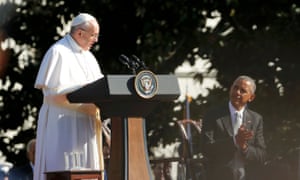
Pope Francis calls for urgent action on climate change in White House speech

Addressing a crowd of nearly 15,000 on the south lawn, pope invokes Martin Luther King Jr in speaking of the moral need to protect our ‘common home’

Pope at White House

Pope Francis enlisted the spirit of Martin Luther King Jr to help bolster his call for urgent action on climate change on Wednesday in a welcoming ceremony at the White House that Barack Obama said would “shake our conscience from slumber”.
Speaking in front of crowd of nearly 15,000 guests that had begun packing into the south lawn before dawn, the pope wasted no time in striking an unashamedly political tone during his first public event of a six-day visit to the US.
In a surprise move, the pope made what amounted to a direct reference toObama’s new emission regulations, which are deeply controversial among Republicans. Before a crowd of VIPs and dignitaries that included lawmakers from both parties, the pope told the president it was “encouraging that you are proposing an initiative for reducing air pollution” at a “crucial moment in history”.
Pope Francis extended the metaphor of injustice to include the need to care for “our common home”.
In words that pile moral pressure on those who oppose carbon emission regulations, the pope said: “It seems clear to me also that climate change is a problem which can no longer be left to a future generation.”
To loud applause, the pontiff said: “To use a telling phrase of the Reverend Martin Luther King, we can say that we have defaulted on a promissory note and now is the time to honor it.”
“We know by faith that the creator does not abandon us; he never forsakes his loving plan or repents of having created us. Humanity still has the ability to work together in building our common home,” he added.
The pope’s explicit reference to the Obama administration’s new proposed regulations makes the comments the most politically charged remarks since Francis began his journey to Cuba and the US. While in Cuba, he encouraged leaders of both countries to keep striving for reconciliation, but he steered clear of any direct references to political controversies on either side, including the trade embargo, and did not meet with political dissidents.
The reference to the moral need to protect our “common home” echoes the pope’s second encyclical, which was published in June, and is seen by Democrats as a crucial step in helping persuade climate sceptics in Washington of the urgency of carbon reduction initiatives.While his support for the new rules are not surprising, given his views on the need for environmental action, it is unusual for the pope to speak about specific government regulation or policy, just as he does not usually mention politicians by name.
The pope, visiting the US for the first time, also drew from King’s “I have a dream” speech, implying there was also a responsibility under the US constitution to tackle climate change. 
King originally accused the US of defaulting on the “promissory note” drawn up by the founding fathers to grant all men inalienable rights, claiming African Americans had been given “a bad check”.
The pope called for action: “Such change demands on our part a serious and responsible recognition not only of the kind of world we may be leaving to our children, but also to the millions of people living under a system which has overlooked them,” he added. “Our common home has been part of this group of the excluded which cries out to heaven and which today powerfully strikes our homes, our cities, our societies.”
Obama paid tribute to the pope for “shak[ing] our conscience from slumber” in a warm welcome that made clear the personal bond between the two men.
“Holy Father, you remind us that we have a sacred obligation to protect our planet – God’s magnificent gift to us,” he said. “We support your call to all world leaders to support the communities most vulnerable to a changing climate and to come together to preserve our precious world for future generations.”
“We are grateful for your invaluable support of our new beginning with the Cuban people, which holds out the promise of better relations between our countries, greater cooperation across our hemisphere, and a better life for the Cuban people,” said Obama.The president also thanked Francis for his diplomatic support for talks between the US and Cuba.
Earlier, a ripple of whoops and cheers swept around the south lawn as the Pope’s familiar white cassock was first spotted against the cream of the White House colonnade. Despite the pomp of military brass bands and Vatican anthem, there was a relaxed atmosphere to the first public event of this highly anticipated visit.
Many of the thousands who have flocked to Washington DC view this papacy as a unifying one that helps underline the role of spirituality in public life. Nonetheless, the sight of the moral leader of millions praising specific – and vexed – environmental regulations alongside Obama was likely an uncomfortable one for many Republicans who had hoped there would be a less explicit political message.
The welcoming ceremony at the White House is only a taste of what might be to come when Pope Francis addresses Congress on Thursday.

Barack Obama's cousin suing London Met police for campaign of harassment

Marie Auma says that after being denied leave at Southwark police station she was bullied by colleagues who would break wind at her desk.
Maria Auma says she was 'belittled' by colleagues
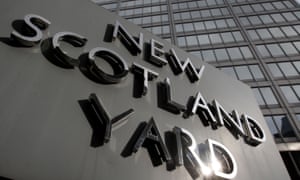
Barack Obama’s British cousin is suing the Metropolitan police for £400,000, claiming she was subjected to a campaign of bullying and humiliation.
Marie Auma, of Palmers Green in north London, says officers and employees pursued a conspiracy against her, including two who deliberately broke wind beside her desk at Southwark police station.
Auma, 57, who was at the US president’s inauguration in 2009, claims she was “belittled and humiliated” by some colleagues when she worked as a civilian in the telephone investigations bureau. She said the campaign against her began when she was refused leave to visit her brothers’ grave after they died in a car crash in Kenya in 2007, resulting in her retirement due to mental health difficulties.
Her barrister, Lorraine Mensah, told Judge Simon Freeland QC at Central London County Court that Auma, whose job involved liaising with crime victims, had been the victim of “21st century bullying”. The Met, represented by barrister Iain Daniels, denies liability.
Mensah said few of the individual incidents that occurred between 2007 and 2009 could be said to be harassment, but together formed a culture of “overzealous, oppressive managing” of Auma, where she was forced to take “inappropriate breaks” making it impossible for her to meet her targets.
She told the court Auma had been branded a troublemaker in the force’s “rumour mill” after she complained at being denied leave to visit Kenya after her brothers’ accident. She said there was a “pack mentality” and that the rumours led directly to an officer and another civilian employee deliberately breaking wind at her desk.
“Most of the behaviour was open,” said Mensah. “The passing of wind at her desk in an open plan office is an attempt to belittle her and humiliate her.”
When the officer was moved to another unit, the number of memos which Auma had to deal with soared, she continued. When she was moved to another unit at Rotherhithe police station, the perception about her followed, to the extent that she was treated differently from her colleagues by more senior staff.
She added: “There was clear evidence before the defendants that she was suffering stress, causing her ill health, and she attributed that to the bullying and harassment that she complained of.”
Auma had to take time off work due to chest pains in the second half of 2008, which she put down to anxiety and stress caused by her situation at work. She eventually suffered a mental breakdown and was admitted to hospital, and never returned to work before she retired due to ill health.
Mensah said the Met could at any time have “controlled or stopped” the harassment and so prevented Auma from mental injury.
Auma is related to Obama through her aunt, Kezia Obama, the president’s stepmother, who lives in Bracknell, Berkshire. In 2009, when Obama became president, she travelled with Kezia Obama to Washington for his inauguration.
The hearing continues.

Thứ Sáu, 4 tháng 9, 2015

President Barack Obama Comments on Humans of New York Facebook Post About 10-Year-Old Iranian Boy

In a rare Facebook response, President Barack Obama says a Humans of New York post about an Iranian boy who showed his humanitarian side by giving away a bag of fruit was "inspirational" and "really resonated" with him as a parent.
A photograph of an Iranian man sitting with a boy was posted on Thursday on the page, which is run by photographer Brandon Stanton, who is on a trip to Iran.
"Today's his 10th birthday," read the photo post, which was also posted on Instagram and liked on Facebook by more than 486,000 people, including CEO Mark Zuckerberg. "He's a very emotional young man. He likes to solve other people's problems."
"One time when he was five years old, he came with me to the store and we bought two pounds of fresh apricots," the post continued. "I let him carry the bag home. He walked a little bit behind me the entire way. After a while, I asked him to hand me an apricot. 'I can't,' he said. 'I've given them all away.' I knew then that I was raising a humanitarian."
President Barack Obama, Tweeting
"What an inspirational story," responded Obama, a father of two daughters, via the White House's Facebook account. "One of the most fulfilling things that can happen to you as a parent is to see the values you've worked to instill in your kids start to manifest themselves in their actions—and this one really resonated with me."
"I hope this young man never loses his desire to help others," he added. "And I'm going to continue doing whatever I can to make this world a place where he and every young person like him can live up to their full potential. (And if I ever get to meet him, I hope he'll save me an apricot!) -bo."
Obama made his comments a day after he secured support from 34 Senate members, the required minimum number, to back an Iran nuclear deal and sustain his promised veto if the Republican-controlled Congress votes in favor of a disapproval resolution. Under the agreement, Iran would curb its nuclear program, deemed by U.S. ally Israel as a security threat, in return for relief of sanctions, which have hurt its economy.
Fellow Democrat and 2016 presidential election candidate Hillary Clinton had responded to a Humans of New York Facebook post in July, commenting on a photo of a gay teenage boy who appeared to be in despair.

Why Barack Obama Still Faces Uphill Battle To Avoid Iran Deal Veto

Now that President Obama has more than the 34 Senate votes needed to uphold a veto and save the Iran nuclear deal, the fight has moved to another, less critical but highly symbolic threshold: winning over 41 senators to filibuster the Senate approval/disapproval vote. That would block the upper chamber from voting on the Iran deal altogether and save the president from having to use the veto.

A filibuster would deny the Republican-controlled Congress the chance to dissociate itself from the administration’s diplomatic achievement. On a symbolic level, it would prevent the nation’s legislative body from announcing formally to the world that the president is on his own at this historic juncture and doesn’t have the backing of the American people.

The odds aren’t on the president’s side, though. The White House has 37 Senate votes in the bag, so it needs four more senators to block cloture, the strange Senate rule that requires 60 votes to bring a bill to the Senate floor for a vote. As of this writing, eight senators haven’t announced a position on the deal, including seven Democrats and a lone Republican, Susan Collins of Maine. (The seven Democrats are listed at the bottom.)

Chuck Schumer is one of only two Democratic senators to come out against the Iran nuclear deal. Richard Blumenthal of Connecticut is still undecided.

Since Collins is unlikely to join a filibuster against her own party, four out of seven Democrats would likely have to agree to back the president and join the filibuster. Put differently, if any four Democrats hold out, the bill to disapprove the deal will go to the floor and pass, forcing a veto. The veto will stand, but the deal’s opponents will have had their chance to make their statement to the world.

Given that the nuclear deal’s survival has been ensured, it might seem senators would have an easier time bucking conservative pressure and standing with their president and party. Of course, that logic works in reverse, too. Since the deal will survive regardless, one could justify a decision to please the right without hurting the president and his historic legacy achievement.

It’s important to remember that the upcoming vote isn’t technically for or against the deal. It’s over letting the Senate vote on the deal. There are many reasons why Democrats, even those who already support the president’s Iran deal, might want to see the deal survive, but wouldn’t want to join a filibuster that could put an extra gloss on his victory but exact a personal cost to them — either to their own political futures or to their sense of democratic fair play.

Among the seven uncommitted Democrats, most have what could be strong reasons to defy a Democratic filibuster bid. Three are up for reelection next year. As it happens, all three are Jewish: Ron Wyden of Oregon, Richard Blumenthal of Connecticut and Michael Bennet of Colorado. That makes them particularly vulnerable to the intense pressure, both emotional and financial, coming from the organized Jewish community to oppose the deal.

How serious a threat might they face if they join a filibuster? Blumenthal comes from a solidly blue state, but it’s also a state with a large, affluent and vocal Jewish community, and Blumenthal is not a charismatic figure with a wide base of support. Giving potential opponents a hook to brand him as unreliable on Israel could hurt.

Bennet and Wyden, by contrast, come from states with much smaller Jewish communities. However, Bennet’s Colorado is at best purple — an electoral tossup — and Bennet’s own numbers have been underwater in recent polling. A show of independence from the White House at this key moment might help him survive next year.

Adding to the emotional intensity, both Bennet and Wyden are children of parents who survived Nazism. Wyden’s parents both fled Nazi Germany during the 1930s. Bennet’s mother was born in the Warsaw Ghetto and smuggled out as an infant; both her parents eventually survived the ghetto and brought her to America as a child. Leaving the politics aside, the specter of an Iranian nuclear attack on Israel that’s been raised repeatedly by Israeli Prime Minister Benjamin Netanyahu must feel enormously personal to them, however unlikely it’s been deemed by most Democrats.

A fourth Jewish senator, Ben Cardin of Maryland, has emerged as the second-most watched Jewish weathervane after deal opponent Chuck Schumer. Though Cardin doesn’t have as large a national media profile as Schumer, they share several key characteristics. 
They’re both from solidly blue states. Both hold Democratic leadership positions, Cardin as ranking Democrat on the crucial foreign relations committee. Schumer is from Brooklyn and has deep, longstanding ties to the borough’s huge Orthodox community, where opinion runs strongly against the nuclear deal; Cardin is from Baltimore, the city whose Orthodox community has a role in local Jewish life second only to New York. Cardin is an active member of an Orthodox synagogue, an important ally of AIPAC on the Senate floor and, unlike Schumer, a member of a family that’s been enormously prominent in organized Jewish community life both locally and nationally for decades. Cardin could go either way, and he’s given no hint how he’ll come down.

Then there’s Joe Manchin of West Virginia, the only one of the seven holdouts who’s from a solidly red state.

Two others, Gary Peters of Michigan and Tim Kaine of Virginia, come from purple toss-up states where reelection is anything but assured. They and Manchin might see denying the filibuster as a way to show some conservative chops to the voters and donors back home when they next face them.

There’s also the possibility that actual conviction plays a role, strange as that may sound in Washington. On that score, The New York Times reported August 25 that unnamed Democrats “are concerned that Mr. Peters’s chief of staff, Eric Feldman, who many Democrats said strongly supports the Israeli government, may be nudging him toward opposition.” That is, convincing him that it’s a bad deal.

Maria Cantwell of Washington comes from a solid blue state and there’s little insight into her reasons for holding out. The New York Times quoted a spokesman saying she was “preoccupied” with the wildfires plaguing the state.

Finally, it should be remembered that the reason the Iran approval vote is on the Senate agenda at all is because of a bill introduced last February by the Republican foreign relations committee chair, Senator Bob Corker of Tennessee. The measure was devised as a compromise with the White House, giving Republicans a way to register their unhappiness with the pending deal but sideswiping a measure that the administration strongly opposed, the Nuclear Weapon Free Iran Act, otherwise known as the Kirk-Menendez bill , which threatened to impose new sanctions on Iran. The administration believed the new sanctions would sabotage the nuclear talks then underway.

Corker’s bill was approved by the Senate in May by a 98-to-1 margin, the sole opponent being Republican Tom Cotton of Arkansas, better known for his open letter in March to the Iranian leadership, with 46 GOP co-signers, disavowing Obama’s authority to sign an agreement with them. The 100th senator, Barbara Boxer of California, was absent for the vote.

Significantly, the Corker bill had 21 Democrats signed on as co-sponsors](https://www.congress.gov/bill/114th-congress/senate-bill/615/cosponsors), including six of the seven current holdouts (excluding Manchin). The other 15 Democratic Corker co-sponsors are now among the 34 who have endorsed the Iran deal. But that doesn’t necessarily mean they’ll back a filibuster. Having put their names on a bill to let the Senate vote the Iran deal up or down, it might be awkward now to back a filibuster and prevent that vote from happening. It would be especially awkward for the four Democratic co-sponsors who represent red states, all of whom have endorsed the deal: Joe Donnelly of Indiana, Claire McCaskill of Missouri, Jon Tester of Montana and Heidi Heitkamp of North Dakota. Manchin, a conservative-leaning red-state Democrat who didn’t co-sponsor the Corker bill, has been quoted as saying that he doesn’t believe it would be democratic to deny Congress the right to vote on an issue of such importance.

Also worth noting: the Corker measure was submitted to the Senate just five weeks after Corker’s January 19 meeting in Israel with Mossad director Tamir Pardo. Corker was accompanied to the meeting by six other senators, including Republicans Lindsey Graham, John McCain and John Barrasso as well as Democrats Tim Kaine and Joe Donnelly plus Independent Angus King. At the meeting, Graham later told the Associated Press , Pardo warned them that the Kirk-Menendez effort to impose new sanctions on Iran would sabotage the nuclear talks then underway. Pardo apparently left them with the clear impression that the Israeli intelligence community was unhappy at the prospect.

It was five weeks later that Corker submitted his measure calling for a congressional vote after the talks, effectively sidestepping the new Menendez-Kirk sanctions that Netanyahu favored but the Mossad opposed. Coincidentally or not, the first five senators to sign on as co-sponsors of Corker’s bill, the day it was first submitted February 27, included four of his six companions at the Pardo meeting: Graham, Kaine, McCain and Donnelly. The first name on the co-sponsors’ list, above those four and immediately behind chief sponsor Corker, was Bob Menendez, then the lone Democrat out on a limb opposing his party and his president.

Here are the holdout Democrats as of September 3:
Michael Bennet, CO; Richard Blumenthal, CT; Maria Cantwell, WA; Ben Cardin, MD; Joe Manchin, WV; Gary Peters, MI; Ron Wyden, OR.