Thứ Tư, 2 tháng 12, 2015

SAVE THE PLANET…FROM BARACK OBAMA

Watching Barack Obama in action at the Paris conference on the phenomenon formerly known as global warming, I have a thought about saving the planet. The planet must be saved from Barack Obama. The man has done enormous damage. We will be living with the consequences for a long time. Living, if we are lucky and if the next president undoes some of the damage he has done. The man is an ideologue as impervious to experience as the worst men who ever lived.
Obama threw our hard-won victory in Iraq to prove a point.
Obama has empowered the mad mullahs of the Islamic Republic of Iran. He gives new meaning to the concept of “signing bonus,” providing for Iran’s recovery of $100B for its profession of good intentions for a period of years — no signing necessary! Michael Doran explicated Obama’s deep thoughts in the Mosaic essay “Obama’s secret Iran strategy.” The mullahs have repaid Obama’s good deeds for the Islamic Republic of Iran with almost shocking contempt. They have his number.
Obama has empowered Vladimir Putin, as Doran also explains in his current Mosaic essay“Our man in Moscow.” Obama has turned over America’s Middle East policy to Putin. Why would he do that?
The estimable Walter Russell Mead lays responsibility for the Syrian refugee crisis at Obama’s feet in the important American Interest column “President Obama’s cynical refugee ploy.”
All the while, China has been conducting offensive operations against the United States in cyberspace and extending its reach through the creation of artificial islands in the South China Sea. Even the New York Times has taken note.
If they have not taken it already, Obama’s actions and inactions portend an enormous human toll with adverse environmental consequences thrown in for good measure. Yet Obama is in Cloud Cuckooland (White House transcript here, video below) talking about imaginary catastrophes in a far-off future:
The reason is because [sic] this one trend — climate change — affects all trends. If we let the world keep warming as fast as it is, and sea levels rising as fast as they are, and weather patterns keep shifting in more unexpected ways — then before long, we are going to have to devote more and more and more of our economic and military resources not to growing opportunity for our people, but to adapting to the various consequences of a changing planet. This is an economic and security imperative that we have to tackle now. And great nations can handle a lot at once.
Obama takes his cue from Book 3 of Gulliver’s Travels, devoting himself to undoing what the scientists of Laputa sought to do. The scientist of Laputa sought to extract sunbeams from cucumbers. Obama would force sunbeams back into the cucumber — to mitigate the phenomenon formerly known as global warming. Swift! thou shouldst be living at this hour. But this might be beyond the powers of the greatest satirist ever to write in English:
You go down to Miami, and when it’s flooding at high tide on a sunny day fish are swimming through the middle of the streets.
Well, okay.
Asked about the shootings in Colorado Springs last week, Obama said this:
I say this every time we’ve got one of these mass shootings: This just doesn’t happen in other countries.
Charles Hurt comments: “He actually said this. In Paris. Not three weeks after gunmen mowed down 129 people enjoying freedom in the French capital.”
I say: Save the planet…from Barack Obama!

Barack Obama and Hillary Clinton Are Not ‘Winning’ Even if They Think They Are

I feel bad for Charlie Sheen. Despite his reckless behavior, I wouldn’t wish bad health or a deadly disease on anyone. But it is interesting to remember that not too long ago Charlie Sheen’s catch-phrase was “WINNING!” That didn’t turn out so well, did it?
What appeared to be “winning” was actually losing. When you’re in a mental haze, either due to mentally illness, or your mind is shrouded by the fog of drugs and alcohol, things aren’t what they appear to be.
I’m been giving a lot of thought to what President Barack Obama, Hillary Clinton and leading Democrats are doing and saying. Some conservatives have compared liberalism to mental illness. Just like Charlie Sheen, Democrats think they are winning. But they are suffering from delusion. They may be headed for a similar rude awakening.
U.S. President Barack Obama attends the 10th East Asia Summit at the 27th ASEAN Summit in Kuala Lumpur, Malaysia, Sunday, Nov. 22, 2015. (AP Photo/Vincent Thian)
Hillary’s husband Bill was elected twice by hiding his true liberal views and trying to appear like a moderate Southern Democrat. Obama was elected twice by hiding his true ultra-liberal views and trying to appear as a moderate and “a uniter, not divider.” Today those lessons are lost or forgotten.
Today virtually every position taken by Obama and Hillary, is in direct opposition to the wishes of the majority of American people. That’s not my opinion. Just look at the polls on each issue. The views and policies spewed and supported by Obama and Hillary are getting more and more extreme. America may be a center right nation, or perhaps at times dead center. But one thing it’s not is extreme radical left.
Yet Obama, Hillary and leading Democrats aren’t even attempting to hide or moderate their views anymore. They are out of the closet. It’s the “Full Monty.” There’s no hiding it anymore. They are loud, proud and extreme left. Democrats can’t even see “center” from their homes anymore.
Here are 15 key points and policies where Obama and Hillary and their socialist cabal think they are “winning” but are actually badly out of step with the America people:
1) Obama’s refusal to halt or even pause the importation of Syrian/Muslim Refugees after the Islamic State attack on Paris.
Polls show American voters are overwhelmingly against Obama.
2) Obama’s refusal to not only enforce “illegal’ immigration laws, but even more extreme – his use of Executive Action to legalize millions, without bothering to get the approval of Congress.
Polls show American voters are solidly against Obama.
3) Obama’s refusal to admit “terrorism” is tied to “radical Islam.” He won’t even say the two words in the same sentence.
Polls show American voters are solidly against Obama.
4) Obama’s refusal to come up with a consistent, well-thought out strategy to combat Islamic State.
Polls show American voters are solidly against Obama.
5) Obama’s refusal to admit Obamacare is a disaster that has killed jobs; damaged small business; stunted GDP growth; bankrupted state health insurance exchanges; and is bleeding middle class Americans to death with dramatically higher premiums, deductibles and co-pays. No matter how much the media tries to cover-up, they can’t hide the truth from voters- because the truth is in our monthly healthcare bills.
Polls show American voters are solidly against Obamacare.
6) Obama’s refusal to drop his obsession with “climate change” and “global warming” even though polls show a large majority of Americans don’t rate it as important.
7) Obama’s refusal to reject the radical “Black Lives Matter” movement and his clear distaste and lack of respect for America’s law enforcement.
Polls show American voters are solidly against Obama.
8) Obama’s refusal to come up with a realistic budget and any semblance of a plan to solve our current economic misery and malaise- ranging from only part-time job created, to the worst workforce participation rate in modern history, to terrible retail sales, to terrible manufacturing numbers, to the worst GDP numbers in the history of America (seven straight years under 3 percent GDP growth for the first time ever).
Polls show American voters solidly disapprove of Obama’s handling of the economy.
9) Obama’s refusal to admit that the jobs and inflation numbers released by government are pure theatre and fraud. The people know “the books are cooked.” Just like with Obamacare, the people know what they hear in the media is a total scam because they know there are no decent full-time jobs and everything they buy costs far more than seven years ago.
10) Obama’s refusal to admit that “Gun Control” is not the answer to violence on our streets. Americans aren’t stupid. They know that Chicago has the strictest gun laws in the country and the most violence on it’s streets- with as many as 50 shot and 20 killed on some weekends. That could be why each time Obama talks about the need for gun control, Americans go out and buy record quantities of guns.
Polls show American voters solidly against Obama (and the highest support for the 2nd Amendment in 25 years).
11) Obama’s refusal to admit that his foreign policies have failed miserably, including his support for “the Arab Spring”…his helplessness to stop or slow Putin…and his infamous “Red Line in the Sand” threat towards Syria’s Assad regime.
Polls show American voters solidly against Obama.
12) More specifically American voters are overwhelmingly against Obama’s Iran Treaty.
13) Obama’s rejection of the Keystone Pipeline to please his radical environmental supporters- despite his own State Department admitting it posed no environmental impact.
Polls show American voters solidly against Obama.
14) Obama’s refusal to allow the prosecution of Lois Lerner, or to even punish in any way the illegal actions of IRS employees who clearly chose to target and persecute conservative groups and critics of the President. Forget punishment. The IRS employees involved received BONUSES.
Polls show American voters solidly against Obama.
15) Obama’s continued obstruction of Congress, completely ignoring the Founding Fathers’ desire for checks and balances on government.
Polls show American voters solidly against Obama’s overreach.
Amazingly, Hillary is not only on board with Obama’s agenda, in many instances she wants to go further to the left (with spending, illegal immigration, importation of Syrian refugees, and gun control). These views run clearly counter to the majority of Americans…and yet Democrats no longer care.
Democrats are fooling themselves. Republican landslides in virtually every race in both November 2014 and just this past November 2015 are signs of the displeasure and anger. It’s only the tip of the iceberg.
In reaction to this indifference, Obama has turned the vast majority of America almost completely red on a local basis. In seven years under President Obama, Democrats have lost an unheard of 900+ state legislature seats, 12 governors, 69 House seats, and 13 Senate seats.
The so-called “Silent Majority” has been awakened and they’re focused and motivated like never before to save America for their children and grandchildren. They will also show up and vote in 2016 like never before. Because they understand this indifference to the wishes of the American people must be punished like never before.
Charlie Sheen was never winning. It only looked that way in his foggy, delusional state. Obama, Hillary and their socialist cabal aren’t winning either. It may look like it to them right now. But this isn’t even close to winning. It is pure madness.
TheBlaze contributor channel supports an open discourse on a range of views. The opinions expressed in this channel are solely those of each individual author.

Thứ Tư, 23 tháng 9, 2015

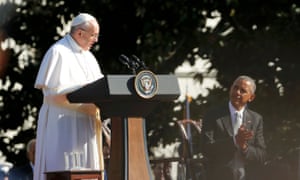
Pope Francis calls for urgent action on climate change in White House speech

Addressing a crowd of nearly 15,000 on the south lawn, pope invokes Martin Luther King Jr in speaking of the moral need to protect our ‘common home’

Pope at White House

Pope Francis enlisted the spirit of Martin Luther King Jr to help bolster his call for urgent action on climate change on Wednesday in a welcoming ceremony at the White House that Barack Obama said would “shake our conscience from slumber”.
Speaking in front of crowd of nearly 15,000 guests that had begun packing into the south lawn before dawn, the pope wasted no time in striking an unashamedly political tone during his first public event of a six-day visit to the US.
In a surprise move, the pope made what amounted to a direct reference toObama’s new emission regulations, which are deeply controversial among Republicans. Before a crowd of VIPs and dignitaries that included lawmakers from both parties, the pope told the president it was “encouraging that you are proposing an initiative for reducing air pollution” at a “crucial moment in history”.
Pope Francis extended the metaphor of injustice to include the need to care for “our common home”.
In words that pile moral pressure on those who oppose carbon emission regulations, the pope said: “It seems clear to me also that climate change is a problem which can no longer be left to a future generation.”
To loud applause, the pontiff said: “To use a telling phrase of the Reverend Martin Luther King, we can say that we have defaulted on a promissory note and now is the time to honor it.”
“We know by faith that the creator does not abandon us; he never forsakes his loving plan or repents of having created us. Humanity still has the ability to work together in building our common home,” he added.
The pope’s explicit reference to the Obama administration’s new proposed regulations makes the comments the most politically charged remarks since Francis began his journey to Cuba and the US. While in Cuba, he encouraged leaders of both countries to keep striving for reconciliation, but he steered clear of any direct references to political controversies on either side, including the trade embargo, and did not meet with political dissidents.
The reference to the moral need to protect our “common home” echoes the pope’s second encyclical, which was published in June, and is seen by Democrats as a crucial step in helping persuade climate sceptics in Washington of the urgency of carbon reduction initiatives.While his support for the new rules are not surprising, given his views on the need for environmental action, it is unusual for the pope to speak about specific government regulation or policy, just as he does not usually mention politicians by name.
The pope, visiting the US for the first time, also drew from King’s “I have a dream” speech, implying there was also a responsibility under the US constitution to tackle climate change. 
King originally accused the US of defaulting on the “promissory note” drawn up by the founding fathers to grant all men inalienable rights, claiming African Americans had been given “a bad check”.
The pope called for action: “Such change demands on our part a serious and responsible recognition not only of the kind of world we may be leaving to our children, but also to the millions of people living under a system which has overlooked them,” he added. “Our common home has been part of this group of the excluded which cries out to heaven and which today powerfully strikes our homes, our cities, our societies.”
Obama paid tribute to the pope for “shak[ing] our conscience from slumber” in a warm welcome that made clear the personal bond between the two men.
“Holy Father, you remind us that we have a sacred obligation to protect our planet – God’s magnificent gift to us,” he said. “We support your call to all world leaders to support the communities most vulnerable to a changing climate and to come together to preserve our precious world for future generations.”
“We are grateful for your invaluable support of our new beginning with the Cuban people, which holds out the promise of better relations between our countries, greater cooperation across our hemisphere, and a better life for the Cuban people,” said Obama.The president also thanked Francis for his diplomatic support for talks between the US and Cuba.
Earlier, a ripple of whoops and cheers swept around the south lawn as the Pope’s familiar white cassock was first spotted against the cream of the White House colonnade. Despite the pomp of military brass bands and Vatican anthem, there was a relaxed atmosphere to the first public event of this highly anticipated visit.
Many of the thousands who have flocked to Washington DC view this papacy as a unifying one that helps underline the role of spirituality in public life. Nonetheless, the sight of the moral leader of millions praising specific – and vexed – environmental regulations alongside Obama was likely an uncomfortable one for many Republicans who had hoped there would be a less explicit political message.
The welcoming ceremony at the White House is only a taste of what might be to come when Pope Francis addresses Congress on Thursday.

Barack Obama's cousin suing London Met police for campaign of harassment

Marie Auma says that after being denied leave at Southwark police station she was bullied by colleagues who would break wind at her desk.
Maria Auma says she was 'belittled' by colleagues
Barack Obama’s British cousin is suing the Metropolitan police for £400,000, claiming she was subjected to a campaign of bullying and humiliation.
Marie Auma, of Palmers Green in north London, says officers and employees pursued a conspiracy against her, including two who deliberately broke wind beside her desk at Southwark police station.
Auma, 57, who was at the US president’s inauguration in 2009, claims she was “belittled and humiliated” by some colleagues when she worked as a civilian in the telephone investigations bureau. She said the campaign against her began when she was refused leave to visit her brothers’ grave after they died in a car crash in Kenya in 2007, resulting in her retirement due to mental health difficulties.
Her barrister, Lorraine Mensah, told Judge Simon Freeland QC at Central London County Court that Auma, whose job involved liaising with crime victims, had been the victim of “21st century bullying”. The Met, represented by barrister Iain Daniels, denies liability.
Mensah said few of the individual incidents that occurred between 2007 and 2009 could be said to be harassment, but together formed a culture of “overzealous, oppressive managing” of Auma, where she was forced to take “inappropriate breaks” making it impossible for her to meet her targets.
She told the court Auma had been branded a troublemaker in the force’s “rumour mill” after she complained at being denied leave to visit Kenya after her brothers’ accident. She said there was a “pack mentality” and that the rumours led directly to an officer and another civilian employee deliberately breaking wind at her desk.
“Most of the behaviour was open,” said Mensah. “The passing of wind at her desk in an open plan office is an attempt to belittle her and humiliate her.”
When the officer was moved to another unit, the number of memos which Auma had to deal with soared, she continued. When she was moved to another unit at Rotherhithe police station, the perception about her followed, to the extent that she was treated differently from her colleagues by more senior staff.
She added: “There was clear evidence before the defendants that she was suffering stress, causing her ill health, and she attributed that to the bullying and harassment that she complained of.”
Auma had to take time off work due to chest pains in the second half of 2008, which she put down to anxiety and stress caused by her situation at work. She eventually suffered a mental breakdown and was admitted to hospital, and never returned to work before she retired due to ill health.
Mensah said the Met could at any time have “controlled or stopped” the harassment and so prevented Auma from mental injury.
Auma is related to Obama through her aunt, Kezia Obama, the president’s stepmother, who lives in Bracknell, Berkshire. In 2009, when Obama became president, she travelled with Kezia Obama to Washington for his inauguration.
The hearing continues.

Thứ Sáu, 4 tháng 9, 2015

President Barack Obama Comments on Humans of New York Facebook Post About 10-Year-Old Iranian Boy

In a rare Facebook response, President Barack Obama says a Humans of New York post about an Iranian boy who showed his humanitarian side by giving away a bag of fruit was "inspirational" and "really resonated" with him as a parent.
A photograph of an Iranian man sitting with a boy was posted on Thursday on the page, which is run by photographer Brandon Stanton, who is on a trip to Iran.
"Today's his 10th birthday," read the photo post, which was also posted on Instagram and liked on Facebook by more than 486,000 people, including CEO Mark Zuckerberg. "He's a very emotional young man. He likes to solve other people's problems."
"One time when he was five years old, he came with me to the store and we bought two pounds of fresh apricots," the post continued. "I let him carry the bag home. He walked a little bit behind me the entire way. After a while, I asked him to hand me an apricot. 'I can't,' he said. 'I've given them all away.' I knew then that I was raising a humanitarian."
President Barack Obama, Tweeting
"What an inspirational story," responded Obama, a father of two daughters, via the White House's Facebook account. "One of the most fulfilling things that can happen to you as a parent is to see the values you've worked to instill in your kids start to manifest themselves in their actions—and this one really resonated with me."
"I hope this young man never loses his desire to help others," he added. "And I'm going to continue doing whatever I can to make this world a place where he and every young person like him can live up to their full potential. (And if I ever get to meet him, I hope he'll save me an apricot!) -bo."
Obama made his comments a day after he secured support from 34 Senate members, the required minimum number, to back an Iran nuclear deal and sustain his promised veto if the Republican-controlled Congress votes in favor of a disapproval resolution. Under the agreement, Iran would curb its nuclear program, deemed by U.S. ally Israel as a security threat, in return for relief of sanctions, which have hurt its economy.
Fellow Democrat and 2016 presidential election candidate Hillary Clinton had responded to a Humans of New York Facebook post in July, commenting on a photo of a gay teenage boy who appeared to be in despair.

Why Barack Obama Still Faces Uphill Battle To Avoid Iran Deal Veto

Now that President Obama has more than the 34 Senate votes needed to uphold a veto and save the Iran nuclear deal, the fight has moved to another, less critical but highly symbolic threshold: winning over 41 senators to filibuster the Senate approval/disapproval vote. That would block the upper chamber from voting on the Iran deal altogether and save the president from having to use the veto.

A filibuster would deny the Republican-controlled Congress the chance to dissociate itself from the administration’s diplomatic achievement. On a symbolic level, it would prevent the nation’s legislative body from announcing formally to the world that the president is on his own at this historic juncture and doesn’t have the backing of the American people.

The odds aren’t on the president’s side, though. The White House has 37 Senate votes in the bag, so it needs four more senators to block cloture, the strange Senate rule that requires 60 votes to bring a bill to the Senate floor for a vote. As of this writing, eight senators haven’t announced a position on the deal, including seven Democrats and a lone Republican, Susan Collins of Maine. (The seven Democrats are listed at the bottom.)

Chuck Schumer is one of only two Democratic senators to come out against the Iran nuclear deal. Richard Blumenthal of Connecticut is still undecided.

Since Collins is unlikely to join a filibuster against her own party, four out of seven Democrats would likely have to agree to back the president and join the filibuster. Put differently, if any four Democrats hold out, the bill to disapprove the deal will go to the floor and pass, forcing a veto. The veto will stand, but the deal’s opponents will have had their chance to make their statement to the world.

Given that the nuclear deal’s survival has been ensured, it might seem senators would have an easier time bucking conservative pressure and standing with their president and party. Of course, that logic works in reverse, too. Since the deal will survive regardless, one could justify a decision to please the right without hurting the president and his historic legacy achievement.

It’s important to remember that the upcoming vote isn’t technically for or against the deal. It’s over letting the Senate vote on the deal. There are many reasons why Democrats, even those who already support the president’s Iran deal, might want to see the deal survive, but wouldn’t want to join a filibuster that could put an extra gloss on his victory but exact a personal cost to them — either to their own political futures or to their sense of democratic fair play.

Among the seven uncommitted Democrats, most have what could be strong reasons to defy a Democratic filibuster bid. Three are up for reelection next year. As it happens, all three are Jewish: Ron Wyden of Oregon, Richard Blumenthal of Connecticut and Michael Bennet of Colorado. That makes them particularly vulnerable to the intense pressure, both emotional and financial, coming from the organized Jewish community to oppose the deal.

How serious a threat might they face if they join a filibuster? Blumenthal comes from a solidly blue state, but it’s also a state with a large, affluent and vocal Jewish community, and Blumenthal is not a charismatic figure with a wide base of support. Giving potential opponents a hook to brand him as unreliable on Israel could hurt.

Bennet and Wyden, by contrast, come from states with much smaller Jewish communities. However, Bennet’s Colorado is at best purple — an electoral tossup — and Bennet’s own numbers have been underwater in recent polling. A show of independence from the White House at this key moment might help him survive next year.

Adding to the emotional intensity, both Bennet and Wyden are children of parents who survived Nazism. Wyden’s parents both fled Nazi Germany during the 1930s. Bennet’s mother was born in the Warsaw Ghetto and smuggled out as an infant; both her parents eventually survived the ghetto and brought her to America as a child. Leaving the politics aside, the specter of an Iranian nuclear attack on Israel that’s been raised repeatedly by Israeli Prime Minister Benjamin Netanyahu must feel enormously personal to them, however unlikely it’s been deemed by most Democrats.

A fourth Jewish senator, Ben Cardin of Maryland, has emerged as the second-most watched Jewish weathervane after deal opponent Chuck Schumer. Though Cardin doesn’t have as large a national media profile as Schumer, they share several key characteristics. 
They’re both from solidly blue states. Both hold Democratic leadership positions, Cardin as ranking Democrat on the crucial foreign relations committee. Schumer is from Brooklyn and has deep, longstanding ties to the borough’s huge Orthodox community, where opinion runs strongly against the nuclear deal; Cardin is from Baltimore, the city whose Orthodox community has a role in local Jewish life second only to New York. Cardin is an active member of an Orthodox synagogue, an important ally of AIPAC on the Senate floor and, unlike Schumer, a member of a family that’s been enormously prominent in organized Jewish community life both locally and nationally for decades. Cardin could go either way, and he’s given no hint how he’ll come down.

Then there’s Joe Manchin of West Virginia, the only one of the seven holdouts who’s from a solidly red state.

Two others, Gary Peters of Michigan and Tim Kaine of Virginia, come from purple toss-up states where reelection is anything but assured. They and Manchin might see denying the filibuster as a way to show some conservative chops to the voters and donors back home when they next face them.

There’s also the possibility that actual conviction plays a role, strange as that may sound in Washington. On that score, The New York Times reported August 25 that unnamed Democrats “are concerned that Mr. Peters’s chief of staff, Eric Feldman, who many Democrats said strongly supports the Israeli government, may be nudging him toward opposition.” That is, convincing him that it’s a bad deal.

Maria Cantwell of Washington comes from a solid blue state and there’s little insight into her reasons for holding out. The New York Times quoted a spokesman saying she was “preoccupied” with the wildfires plaguing the state.

Finally, it should be remembered that the reason the Iran approval vote is on the Senate agenda at all is because of a bill introduced last February by the Republican foreign relations committee chair, Senator Bob Corker of Tennessee. The measure was devised as a compromise with the White House, giving Republicans a way to register their unhappiness with the pending deal but sideswiping a measure that the administration strongly opposed, the Nuclear Weapon Free Iran Act, otherwise known as the Kirk-Menendez bill , which threatened to impose new sanctions on Iran. The administration believed the new sanctions would sabotage the nuclear talks then underway.

Corker’s bill was approved by the Senate in May by a 98-to-1 margin, the sole opponent being Republican Tom Cotton of Arkansas, better known for his open letter in March to the Iranian leadership, with 46 GOP co-signers, disavowing Obama’s authority to sign an agreement with them. The 100th senator, Barbara Boxer of California, was absent for the vote.

Significantly, the Corker bill had 21 Democrats signed on as co-sponsors](https://www.congress.gov/bill/114th-congress/senate-bill/615/cosponsors), including six of the seven current holdouts (excluding Manchin). The other 15 Democratic Corker co-sponsors are now among the 34 who have endorsed the Iran deal. But that doesn’t necessarily mean they’ll back a filibuster. Having put their names on a bill to let the Senate vote the Iran deal up or down, it might be awkward now to back a filibuster and prevent that vote from happening. It would be especially awkward for the four Democratic co-sponsors who represent red states, all of whom have endorsed the deal: Joe Donnelly of Indiana, Claire McCaskill of Missouri, Jon Tester of Montana and Heidi Heitkamp of North Dakota. Manchin, a conservative-leaning red-state Democrat who didn’t co-sponsor the Corker bill, has been quoted as saying that he doesn’t believe it would be democratic to deny Congress the right to vote on an issue of such importance.

Also worth noting: the Corker measure was submitted to the Senate just five weeks after Corker’s January 19 meeting in Israel with Mossad director Tamir Pardo. Corker was accompanied to the meeting by six other senators, including Republicans Lindsey Graham, John McCain and John Barrasso as well as Democrats Tim Kaine and Joe Donnelly plus Independent Angus King. At the meeting, Graham later told the Associated Press , Pardo warned them that the Kirk-Menendez effort to impose new sanctions on Iran would sabotage the nuclear talks then underway. Pardo apparently left them with the clear impression that the Israeli intelligence community was unhappy at the prospect.

It was five weeks later that Corker submitted his measure calling for a congressional vote after the talks, effectively sidestepping the new Menendez-Kirk sanctions that Netanyahu favored but the Mossad opposed. Coincidentally or not, the first five senators to sign on as co-sponsors of Corker’s bill, the day it was first submitted February 27, included four of his six companions at the Pardo meeting: Graham, Kaine, McCain and Donnelly. The first name on the co-sponsors’ list, above those four and immediately behind chief sponsor Corker, was Bob Menendez, then the lone Democrat out on a limb opposing his party and his president.

Here are the holdout Democrats as of September 3:
Michael Bennet, CO; Richard Blumenthal, CT; Maria Cantwell, WA; Ben Cardin, MD; Joe Manchin, WV; Gary Peters, MI; Ron Wyden, OR.

Thứ Hai, 10 tháng 8, 2015

Obama to hit US power plants with tougher than expected emissions cuts

The president will announce a 32% cut in greenhouse gas emissions by 2030 in what he calls America’s biggest ever step against climate change
Barack Obama in the Oval office. Climate change is not a problem for another generation, he said.

President Barack Obama will impose even steeper cuts on greenhouse gas emissions from US power plants than previously expected, senior administration officials said on Sunday, in what the president called the most significant step the US has ever taken to fight global warming.
A year after proposing unprecedented carbon dioxide limits, Obama was poised to finalize the rule at a White House event on Monday. In a video posted to Facebook, Obama said the limits were backed up by decades of data showing that without tough action, the world will face more extreme weather and escalating health problems like asthma.
“Climate change is not a problem for another generation,” Obama said. “Not anymore.”
Opponents vowed to sue immediately, and planned to ask the courts to put the rule on hold while legal challenges play out. Many states have threatened not to comply.
In his initial proposal, Obama had mandated a 30% nationwide cut in carbon dioxide emissions by 2030, compared to 2005 levels. The final version will require a 32% cut instead, said the officials, who weren’t authorized to comment by name and requested anonymity.
The final rule also gives states an additional two years until 2022 to comply, officials said, yielding to complaints that the original deadline was too soon. States will also have until 2018 instead of 2017 to submit their plans for how they’ll meet their targets.
But the administration will attempt to incentivize states to take action earlier by offering credits to states that boost renewable sources like wind and solar in 2020 and 2021, officials said.
The focus on renewables marks a significant shift from the earlier version that sought to accelerate the ongoing transition from coal-fired power to natural gas plants, which emit far less carbon dioxide. The revised rule aims to keep the share of natural gas in the nation’s power mix at current levels.
The stricter limits in the final plan were certain to incense energy industry advocates who had already balked at the more lenient limits in the proposed plan. But the Obama administration said its tweaks would cut energy costs and address concerns about power grid reliability.
The Obama administration previously predicted the emissions limits will cost up to $8.8bn annually by 2030, although it said those costs would be far outweighed by health savings from fewer asthma attacks and other benefits. The actual price won’t be clear until states decide how they will reach their targets.
America’s largest source of greenhouse gases, power plants account for roughly one-third of all US emissions of carbon dioxide and other heat-trapping gases blamed for global warming. Obama’s rule assigns customized targets to each state, then leaves it up to the state to determine how to meet them.
In the works for years, the power plant rule forms the cornerstone of Obama’s plan to curb US emissions and keep global temperatures from climbing, and its success is pivotal to the legacy Obama hopes to leave on climate change. Never before has the US sought to restrict carbon dioxide from existing power plants.
By clamping down on power plant emissions, Obama is also working to increase his leverage and credibility with other nations whose commitments he’s seeking for a global climate treaty to be finalized later this year in Paris. As its contribution to that treaty, the US has pledged to cut overall emissions 26% to 28% by 2025, compared to 2005.
Even before the rule was finalized, more than a dozen states announced plans to fight it. At the urging of Senate majority leader Mitch McConnell of Kentucky, some Republican governors have declared they simply won’t comply, setting up a certain confrontation with the Environmental Protection Agency, which by law can force its own plan on states that fail to submit implementation plans.
Yet even in many of those states, power companies and local utility authorities have started preparing to meet the targets. New, more efficient plants that are replacing older and dirtier ones have already pushed emissions down nearly 13% since 2005, putting them about halfway to meeting Obama’s goal.
In Congress, lawmakers have sought to use legislation to stop Obama’s regulation. McConnell has also tried previously to use an obscure, rarely successful maneuver to allow Congress to vote it down.
The more serious threat to Obama’s rule will likely come in the courts. The Electric Reliability Coordinating Council, which represents energy companies, said 20 to 30 states were poised to join with industry in suing over the rule. The Obama administration has a mixed track record in fending off legal challenges to its climate rules.

Chủ Nhật, 2 tháng 8, 2015

Obama to hit US power plants with tougher than expected emissions cuts

The US president will announce a 32% cut in greenhouse gas emissions by 2030 in what he calls America’s biggest ever step against climate change
Barack Obama in the Oval office. Climate change is not a problem for another generation, he said.

President Barack Obama is planning to impose tougher than expected cuts on greenhouse gas emissions from US power plants, White House officials have said.
A year after proposing unprecedented carbon dioxide limits, the Obama administration was poised to finalise the rule at a White House event on Monday. 
The president called it most significant step the US has ever taken to fight global warming. 
Obama, in a video posted to Facebook, said the limits were backed up by decades of data and facts showing that without tough action the world will face more extreme weather and escalating health problems like asthma. 
“Climate change is not a problem for another generation,” he said. “Not anymore.” 
In his initial proposal, Obama had mandated a 30% nationwide cut in carbon dioxide emissions by 2030, compared to 2005 levels. 
The final version, which follows extensive consultations with environmental groups and the energy industry, will require a 32% cut instead, according to Obama administration officials, who were not authorised to comment by name and requested anonymity. 
Opponents said they would sue the government immediately. They also planned to ask the courts to put the rule on hold while legal challenges play out. 
The final version also gives states an additional two years – until 2022 – to comply, yielding to complaints that the original deadline was too soon. States will also have until 2018 instead of 2017 to submit their plans for how they intend to meet their targets. 

Why Obama doesn’t understand the lust for power of our African leaders

Even before the dust could settle on President Barack Obama’s candid criticism of African presidents who manipulate their constitutions so that they can stay longer in power, Uganda’s president, Yoweri Museveni – once the west’s model of a truly democratic leader – was on his way again to contest the presidential seat he has held for 30 years. From Rwanda to the Democratic Republic of Congo, Burundi to Zimbabwe, Africa’s big men replied to Obama: this oppression – the shackles, the poverty and indignity – are what the African people have chosen. Tedros Adhanom, the foreign minister of Ethiopia, home of the African Union, defended African leaders who cling to power, saying: “Because they made the law, they can change the law.”
Museveni was echoing the actions of Pierre Nkurunziza of Burundi, Paul Kagame of Rwanda, Robert Mugabe of Zimbabwe and indeed all African leaders who have sought to manipulate the law for a chance at eternal presidency. Adhanom proposed that the extension of term limits was acceptable if it had popular support. It is this type of apologist politics that has kept Africa in its current state – a continent of people who accept lacklustre leaders in the belief that there is a miraculous star shining somewhere at the end of the tunnel of bad leadership. It is this desperate need to cling to power, for no apparent reason and to no end, that Obama does not understand.
This lack of understanding of how things work in Africa, Africa’s big men are quick to point out, is a result of their son, Obama, being overly indoctrinated in the ways of the west. To the advocates of Africa’s new and emerging autocrats such as Andrew Mwenda, a former opposition-leaning journalist turned informal PR for the governments of Uganda and Rwanda, Obama is a puppet whose African ancestry is being used by the US to further its agenda of exploitation. And, Mwenda argues in an opinion article for Al Jazeera, Africa should not listen to anything Obama says.
In fact, if African leaders could place Obama across their thighs and spank him until he forgot his western ways and got some good African sense into his head, they would. For one thing, this errant African son does not know what it is like to fight for the loot that is your country. Museveni, who took power after waging a five-year guerrilla war, has compared the demands that he leave office to a hunter killing his animal and then being asked to leave before he can eat the meat.
To African leaders, Obama’s solutions for Africa are untenable. They view him as detached from the challenges and realities of an African leader. For starters, this African son has one wife and no known concubines. No wonder he comes up with wayward ideas such as educating more African women. Does he know how hard it would be to convince a scientist, engineer or entrepreneur to become a second wife? Does he know how many legal cases African countries would have to deal with if most of the masses – whose human-rights violations nosy organisations such as Human Rights Watch and Amnesty International do not tire of reporting – were educated and employed rather than hungry and destitute?
The reality is that these African leaders do not realise that their argument that human rights, dignity and democracy are a western concept force-fed to the African continent no longer holds water. Its demise happened around the time when Bakayoko, the protagonist in Senegalese writer Ousmane Sembène’s God’s Bits of Wood, declared that dignity, good food, water and housing, are not for white people – they are for people. The notion that human rights and democracy – the kind that Obama speaks about – are not African was stripped of all legitimacy when African leaders, evoking the universal declaration of human rights and drawing inspiration from the French and American revolutions, demanded self governance and equality. They made these demands in English, French, Portuguese and other languages that their tyrants would understand. With their sweat and blood, they adopted human rights, made them African and used these ideals to liberate the continent from colonialism. It is baffling that these same people now dare to reject such ideals as being foreign. With worrying nostalgia, some Africans of an older generation will tell you that colonialism was so much better than the governments they live under. If African leaders cared, it is this kind of talk that would keep them up at night and push them to do whatever it takes to perform better.
But, as Chatham House Africa researcher Ahmed Soliman observes, even after Obama’s speech, successful and peaceful transfers of power in Africa will remain the exception rather than the rule. You can be sure that when the African Union meets in January next year, in the same hall where Obama made his historic admonishment, Africa’s power-clingers will still pat themselves on the back for the incredible job that they have done turning the continent into one on the move. They will have a selective memory of Obama’s speech, remembering only the parts where Africa was hailed as young, prosperous and vibrant. They will forget Obama’s warning of the fragile foundations on which the continent stands.
And yet, like it or not, Obama’s presence in the hall will be haunting and taunting the delegates. His message will not be exorcised. And even as they publicly act nonchalant about it, they will go home and think of the potent words of the first African-American US president. At the next AU meeting, there will be some countries that are still the marvel of the continent and a sting on the consciences of the power–clingers. Kenya, Tanzania, Nigeria, Senegal, Botswana, Ghana and others that strive to respect that basic facet of democracy called “term limits” will be a reminder that perhaps the continent is not doomed after all.
By the time the children who were born during Obama’s Africa visit will be crawling, the reality of a continent that is rising but not rising will have set in. With it will also come the realisation that a good guest is not one who brings food so that you can feast together for days and grow fatter. A good guest is one who brings you a hoe so that you can dig and have food for the rest of your life.
Obama may be blamed for not making grandiose announcements about increased aid during his visit, but his powerful words are the kind of inspirational tool we Africans – both young and old – need to lift our downtrodden and intimidated souls and reminds us that even our grandfathers can and should be challenged when they err.

US judge rejects Guantánamo detainee's unlawful imprisonment challenge

Muktar Yahya Najee al-Warafi argues his detention is unlawful since Obama declared end to war with Afghanistan but judge says involvement continues
guantanamo bay

A US judge on Thursday rejected a legal challenge from a Guantánamo Bay detainee who said his imprisonment was unlawful now that President Barack Obama has declared an end to hostilities in Afghanistan.
Muktar Yahya Najee al-Warafi, a Yemeni who was captured in Afghanistan, has been held since 2002 at the prison in Cuba for terror detainees. Judges have upheld his detention on grounds that he likely aided Taliban forces, though his lawyers have said he was simply a medic.
His latest challenge centered on Obama administration statements in the last year indicating that the war in Afghanistan had come to an end. His lawyers said that those assertions made his detention unlawful under the Authorization for the Use of Military Force, which provided the legal justification for the imprisonment of foreign fighters captured on overseas battlefields. The supreme court stressed in a 2004 opinion, Hamdi v Rumsfeld, that such detention is legal only as long as “active hostilities” continue.
US district judge Royce Lamberth wrote in a 14-page opinion that the president’s statements notwithstanding, the government had offered “convincing evidence that US involvement in the fighting in Afghanistan, against al-Qaida and Taliban forces alike, has not stopped”. Al-Warafi’s detention therefore remains legal, he said.
“A court cannot look to political speeches alone to determine factual and legal realities merely because doing so would be easier than looking at all the relevant evidence,” Lamberth wrote. “The government may not always mean what it says or say what it means.”
Brian Foster, a lawyer for al-Warafi, said the judge’s opinion amounted to a “rubber stamp for endless detention”. He said he would review the opinion and decide whether to appeal.
A similar petition is pending before another judge in Washington from Faez Mohammed Ahmed al-Kandari, a Kuwaiti who was shipped to Guantánamo following his 2001 capture after the battle of Tora Bora.

Chủ Nhật, 26 tháng 7, 2015

Obama meets new Nigerian president with praise for anti-extremist agenda

Barack Obama welcomed Nigeria’s new president to the Oval Office on Monday and praised him for working to bring “safety, security and peace” to a nation challenged by economic strains, a history of corruption and violence unleashed by the Islamic extremist group Boko Haram.
obama buhari nigeria
Obama met with President Muhammadu Buhari less than eight weeks after Buhari took office, to underscore the importance the US attaches to good relations with Nigeria.
The US president said Buhari had “a very clear agenda in defeating Boko Haramand extremists of all sorts inside of his country.
“And he has a very clear agenda in terms of rooting out the corruption that too often has held back the economic growth and prosperity of his country,” Obama said.
Obama, speaking to reporters at the outset of the meeting, said the US hoped to partner with the African nation “so that Nigeria ends up being not only an anchor of prosperity and stability in the eastern part of the continent, but can also be an outstanding role model for developing countries around the world”.
He said he would discuss with Buhari how the two nations can cooperate on counter-terrorism and how the US “can be helpful in addressing some of the corruption issues that have held Nigeria back”.
Buhari said Nigeria would be “ever grateful” to the US for its support of free elections in his country. Buhari said US and European pressures to ensure the election was “fair and credible led us to where we are now”.
US relations with Nigeria soured over failures by the government and military, including the inability to locate more than 200 schoolgirls, most of them Christian, who were kidnapped by Boko Haram from the northern town of Chibok in April 2014. The abduction led to international condemnation and a campaign to “Bring Back Our Girls” that reached as far as the White House.
The then president Goodluck Jonathan was angered by the US refusal to sell his government helicopter gunships and retaliated by halting a US military training programme.
Relations are expected to improve under Buhari, a 72-year-old former military dictator who has pledged allegiance to democracy and promised to address US concerns.
Obama extended his invitation for a visit to Buhari almost immediately after he was declared the winner of the March election.
“This feels to us like Nigeria is at an important moment in which there can be real reforms across the board,” Grant Harris, the senior director for African affairs at the National Security Council, told reporters last week.
“We’re looking forward to what we can do with a president who has staked out an agenda that we think is the right agenda at the right time.”
Nigeria’s new leader has been criticized for being slow to form a cabinet. He has yet to name any ministers.
Last week, Buhari fired the entire top echelon of the military, which he has accused of corruption that prevents what once was Africa’s mightiest armed force from curbing the Islamist insurgency based in Nigeria’s northeast. The insurgency has killed more than 13,000 people and driven another 1.5 million from their homes.
Besides the Oval Office meeting with Obama, Buhari is to meet with Vice-President Joe Biden, Secretary of State John Kerry and other senior administration officials.

Obama says Iran deal 'will make world safer' as Republicans plot opposition

The Iran nuclear deal “will make America and the world safer and more secure”, President Barack Obama said on Saturday.
The 159-page agreement between six world powers and Iran was finalized this week in Vienna, after extensive talks. On Saturday, Obama used his weekly address to seek support among voters, prior to the congressional vote on the deal and against a backdrop of Republican-led opposition.
“This deal will make America and the world safer and more secure,” Obama said. “Still, you’re going to hear a lot of overheated and often dishonest arguments about it in the weeks ahead.”
The president used the four-and-a-half-minute address to explain “what the deal does and what it means”.
The deal, he said, closes off Iran’s pathway to nuclear weapons; allows for “unprecedented” 24/7 monitoring of key nuclear facilities; and gives international inspectors access to the country’s nuclear supply chain. If Iranviolates the deal, Obama said, sanctions will snap back into place.
The president said the talks took so long because the US “refused to accept a bad deal”. The deal that was reached meets “every one of our bottom lines”, he said.
Before it can be implemented, the agreement must pass through Congress. It is unlikely to be defeated, but some Republicans have indicated that they will nonetheless attempt to do so.
“If in fact it’s as bad a deal as I think it is at this moment, we’ll do everything we can to stop it,” John Boehner, the speaker of the House, said earlier this week. 
Bob Corker, the Republican chair of the Senate foreign relations committee, said he would hold hearings to ensure members of Congress know what they are voting on.
“Those who believe that this truly is going to keep Iran from getting a nuclear weapon will vote for it,” he told reporters. “Those who believe that is not the case, and the world is not going to be safer – and in some ways it may pave the way for them to get a nuclear weapon – will vote against it.”
Republican 2016 presidential candidates have not minced their words. Among them, Governor Scott Walker of Wisconsin said the deal would be remembered as “one of America’s worst diplomatic failures”; Florida senator Marco Rubio said Obama had negotiated “from a position of weakness”, conceding to a regime that “holds Americans hostage”; and former Arkansas governor Mike Huckabee said the deal “empowers an evil Iranian regime” to carry out its threat to bring death to America.
Among those supporting the Iran nuclear deal is the former secretary of state and 2016 Democratic frontrunner Hillary Clinton.
“Based on the briefings I received and a review of the documents, I support the agreement because it can help us prevent Iran from getting a nuclear weapon,”Clinton said.
She added that signing the agreement was the beginning, implying that enforcement and compliance might prove difficult.
In his address, Obama did not shy away from criticism.
“On questions of war and peace, we should have tough, honest, serious debates,” he said. “We’ve seen what happens when we don’t. That’s why this deal is online for the whole world to see. I welcome all scrutiny. I fear no questions.
“As commander-in-chief, I make no apology for keeping this country safe and secure through the hard work of diplomacy over the easy rush to war.”
Obama plans to promote the deal on Tuesday, when he is due to address the national convention of Veterans of Foreign Wars.
“We have before us an historic opportunity to pursue a safer, more secure world for our children,” he said. “It might not come around again in our lifetimes.
“That’s why we’re going to seize it today – and keep America a beacon of hope, liberty, and leadership for generations to come.”